Reviewed · BIG ISLAND NATIONAL PARK TOURS
Hawaii Volcanoes National Park Self-Guided Driving Audio Tour
The best thing about this tour is that it gives the enormous park a clear shape. Instead of staring at a map and guessing which crater, trail, or overlook matters most, you follow a 24.5-mile route with audio stories that begin automatically as you drive. I like the GPS-triggered narration and the freedom to stop for photos, short walks, or lunch without a group waiting.
I also like the price: $16.99 per group of up to four is a strong deal compared with a traditional guided excursion. The main catch is setup. You must download the separate app and tour while you have good service, and the route works best in its recommended direction rather than in reverse.
Key things to know before you go
- More than 43 audio stories cover volcanic features, Hawaiian mythology, local history, and practical points along the road.
- The route runs 24.5 miles, from the park entrance station to Hōlei Sea Arch.
- The price covers the car group, not just one person, so four people can share the same purchase.
- Offline access matters, since cellular service may be weak in parts of the park.
- The sea arch is the grand finale, but it takes time to reach, so do not turn around too early.
- The app is flexible but not foolproof. Install it, enter the password, and test it before arriving at the park.
A smart way to see Hawaii Volcanoes National Park
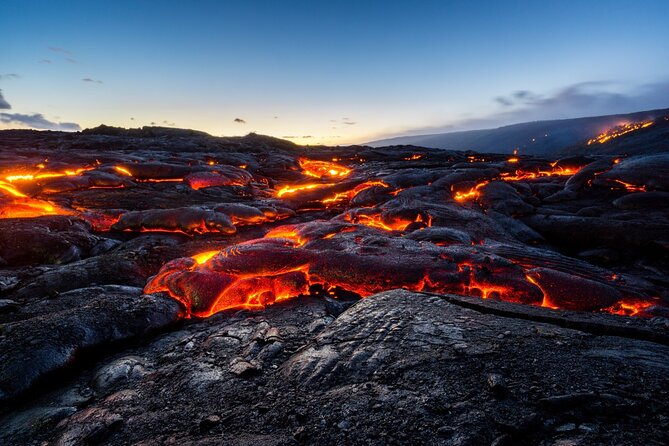
Hawaii Volcanoes National Park is not a quick roadside attraction. The main route moves through steaming ground, giant craters, old lava flows, rain forest, archaeological sites, and the coast. Much of what you see can look stark or subtle at first, so good narration makes a real difference.
This driving tour fills that role without putting you on a bus. You use your own car, set your own pace, and decide how long to stay at each stop. The stories play based on your location, so you can keep your eyes on the road instead of trying to read paragraphs from a phone.
The advertised drive takes about two to three hours, but that is best understood as the basic route with brief stops. Add the Kīlauea Iki Trail, Thurston Lava Tube, Sulphur Banks Trail, or Puʻu Loa Petroglyphs, and you can easily spend much longer in the park. One useful tip is to drive at the posted speed limit. The narration is timed to the route, and driving too fast can cause you to reach the next point before a story has finished.
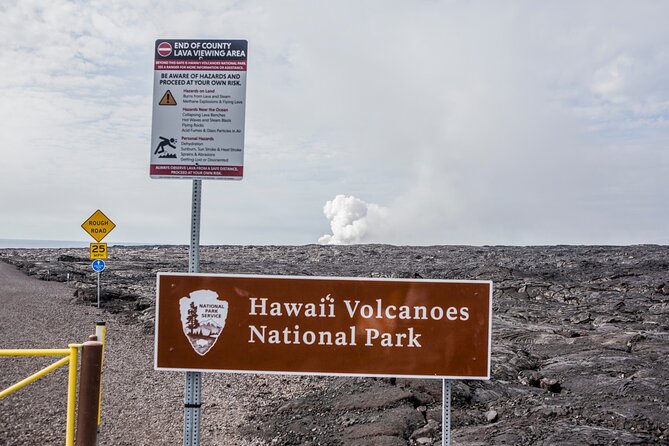
The tour begins at the Entrance Station near Volcano, Hawaii, and ends at Hōlei Sea Arch on Chain of Craters Road. No guide meets you there. You simply open the Action Tour Guide app, select the route, and enter the first story point. After that, the GPS does the work.
More Volcano National Park Tours in the USA
- Hilo Shore Excursion: Volcanoes National Park & Black Sand Beach
★ 4.5 · 2,338 reviews - Big Island: Fat Tire E-Bike Tour through Volcanoes National Park
★ 5.0 · 546 reviews - Big Island, Hawaii: Volcanoes National Park Safari
★ 4.5 · 545 reviews
Kīlauea Military Camp and the park entrance
The first stop is Kīlauea Military Camp, a recreational facility for soldiers with a much darker wartime past. During World War II, the site was used as an internment camp for Japanese Americans as well as prisoners of war.
That history gives the opening section more weight than a simple introduction to park services. The tour connects the present-day recreation area with a painful chapter in American history. Plan roughly ten minutes here if you want a quick orientation and the audio story.
The park entrance and visitor center area are useful places to get your bearings, but remember that the national park entrance fee is separate. The audio purchase does not include admission, attraction tickets, or reservations.
Steam Vents and the unpleasant Sulphur Banks
At the Steam Vents, groundwater heated by Kīlauea rises through cracks in the earth. White steam drifts from the ground, giving you a direct look at heat still moving below the surface.
This is one of the easiest stops to appreciate because you do not need a long hike or special preparation. The audio explains why the vents form and why they can serve as signs of activity underground. Give yourself about ten minutes, and take care around the edges of marked areas.
Nearby, the Sulphur Banks Trail offers a short walk through volcanic gases and mineral deposits. The name is honest. The smell can be strong, and the route is not a sweet-smelling garden stroll. Still, this is exactly the sort of stop that benefits from narration because the odd colors, steam, and odor make more sense when you know what causes them.
Kīlauea Overlook and Kīlauea Iki
Kīlauea Overlook is one of the route’s major visual moments. The crater is broad and does not look like the classic cone-shaped volcano many people expect, but Kīlauea is one of the world’s most active volcanic areas.
The tour helps you read the view instead of simply taking a quick photo and moving on. Allow about ten minutes for the overlook, though you may want longer if weather and visibility are good.
The Kīlauea Iki Trailhead is more than a photo stop. The 3.3-mile loop crosses the Kīlauea Iki Crater and takes about three hours, with elevation changes that can feel strenuous. The driving tour introduces the trail, but it does not replace the time needed to hike it.
If you only have an afternoon, you can hear the story and continue. If you have half a day, this is one of the best places to pause the audio and walk. Bring the right footwear and allow enough time to return to your car before continuing the road route.
More Volcano National Park Tours in Big Island:
- Small-Group Big Island Tour: Hawaii Volcanoes National Park and Kona Coffee Farm
★ 5.0 · 343 reviews - Volcano National Park Adventure From Kona
★ 5.0 · 339 reviews - Private Tour: Hawaii Volcanoes National Park Eco Tour
★ 5.0 · 276 reviews - Volcano National Park Adventure from Waikoloa
★ 5.0 · 216 reviews
Thurston Lava Tube and Luamanu Crater
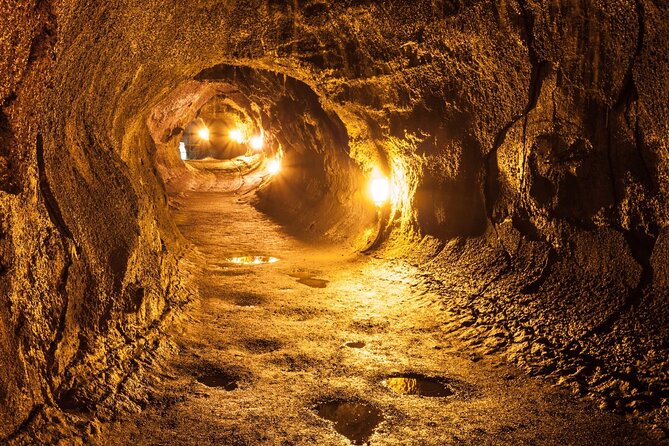
Nāhuku, also called Thurston Lava Tube, was created when molten lava flowed through the area. The outside cooled and hardened while lava continued moving inside, leaving a tunnel that visitors can explore.
It is an easy-to-understand example of how a lava flow can create something hollow beneath the surface. The tour gives you the basic story before you walk in, which makes the formation easier to picture. This is a popular stop, so your experience may depend on how busy the site is when you arrive.
Luamanu Crater offers a different kind of story. It once held dense forest, but that changed in a single day. The point here is not just the shape of a crater. It is the sudden way volcanic events can replace an ecosystem with bare rock.
These stops work well together. The lava tube shows what molten rock can leave behind underground, while Luamanu shows how quickly the surface can change.
The chain of craters: Puhimau, Pauahi, and Puʻu Huluhulu
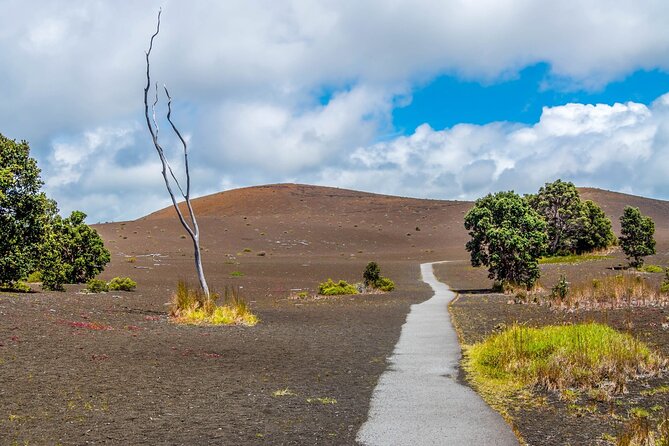
Puhimau Crater is another reminder that the park is full of volcanic forms that do not fit the usual postcard image. You can see geological features shaped by volcanic activity without needing a long walk at every stop.
Pauahi Crater is more dramatic. This steep-sided pit is about 330 feet deep and 1,000 feet across. Lava spatter deposits and fumaroles add detail to the crater walls, while steam and gases show that the ground here is not simply an old, finished monument.
The route then reaches Puʻu Huluhulu, a cinder cone whose name means hairy hill. Low shrubs cover the cone and give it a fuzzy appearance from a distance. It is a small but memorable example of how plants return to volcanic ground.
The audio is especially useful along this section because several craters can blur together if you are rushing. Each one has a different shape and story, and the route gives you a reason to stop rather than treating them as interchangeable viewpoints.
Kipuka Puaulu and Mauna Ulu
Kipuka Puaulu Trail shows how life can survive inside a field of newer lava. A kipuka forms when lava flows around an older patch of vegetation, leaving an island of older plant life surrounded by younger rock.
The contrast is the point. You move from harsh, exposed lava into an area with its own soil, moisture, and plant life. The trail is a good choice if you want a short walk that shows more than volcanic rock and steam.
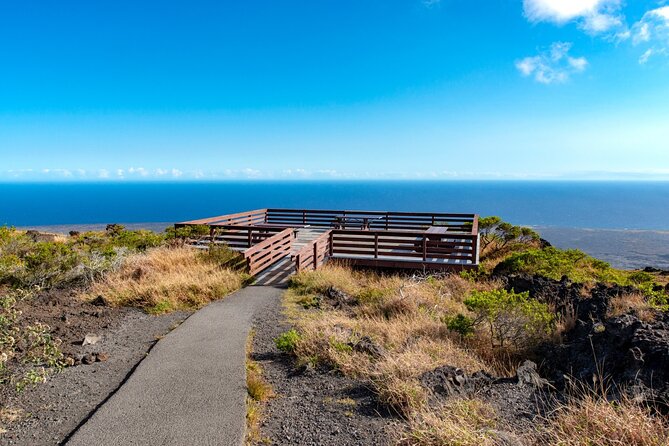
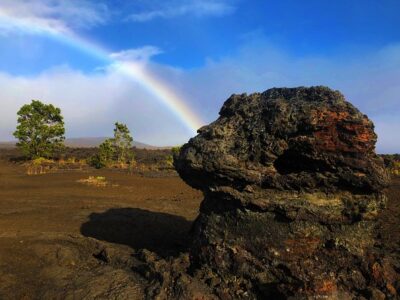
At Mauna Ulu Lookout, a raised platform looks across the Mauna Ulu lava flow. Much of the view is flat and gray, but look for the toadstool-shaped formations. These shapes reward patience and a little help from the narration.
This part of the drive is less about one huge viewpoint and more about noticing small clues. The app helps by giving you something specific to look for, which is useful when the lava field first appears plain.
Puʻu Loa Petroglyphs and the long road to the sea

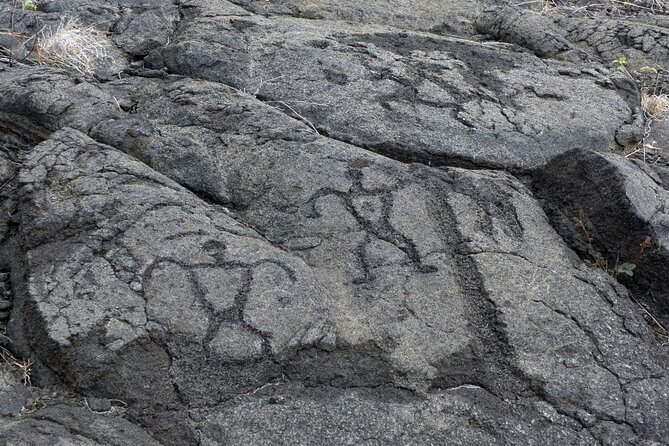
Puʻu Loa Petroglyphs is one of the most culturally important stops on the route. More than 23,000 ancient petroglyphs are etched into hardened lava rock.
Do not treat this as a quick roadside photo stop. The markings are fragile and meaningful, so stay on the designated path and do not touch the rock. The audio adds context to what you are seeing, helping you understand that this is an archaeological site, not merely an unusual collection of scratches.
The drive continues toward the coast, and this is where time planning matters most. If you have only two hours, you may need to limit your walks and keep moving. If you want to hear all the stories and explore the sites properly, give yourself closer to three or four hours.
The GPS can follow your position if you take a brief side trip or visit stops out of order, but the experience works best when you stay near the planned route. One of the more useful features is the ability to pause the tour and resume later. You can spread the visit across more than one day because access does not expire.
Hōlei Sea Arch is worth the extra drive
The tour ends at Hōlei Sea Arch on the coast, where the sea has naturally cut an arch into the cliff. It is the route’s most obvious grand finale, and I would make the effort to reach it if road and park conditions allow.
The drive down Chain of Craters Road is part of the experience. The changing volcanic scenery gives the earlier crater stops a larger context, and the audio adds Hawaiian mythology and local stories along the way.
Do not assume the sea arch is a quick detour from the entrance. It is the end of the 24.5-mile route, so build your day around reaching it. The final stop is especially valuable for anyone who otherwise might spend all their time near the visitor center and miss the coast.
What the $16.99 price really buys you
At $16.99 per group of up to four, this is priced more like a helpful travel tool than a full guided excursion. Four people sharing a car pay less per person than one person traveling alone, but even a solo visitor gets an inexpensive alternative to a large organized tour.
The real value is flexibility. You are not paying for a fixed departure, a group schedule, or a guide who must move on when you want to stay. You can repeat a story, skip a stop, pause for a hike, or continue after a meal.
The tradeoff is that you do not receive a person in the car to answer questions in real time. The narrator is not named in the supplied information, though the audio is designed to provide engaging stories and directions. If you want a personal guide, this is not that product.
There is also a free National Park app with written information and its own self-paced features. This paid tour makes its case through automatic audio, offline access, and hands-free GPS prompts. If you prefer reading facts on your own, the free option may be enough. If you want someone to tell you what you are seeing while you drive, $16.99 is reasonable.
Setup, phone service, and small technical risks
Download the separate Action Tour Guide app before you arrive. After booking, you receive setup instructions and a password by email and text. Search for audio tour if you do not see the message right away.
You must download the tour over strong Wi-Fi or cellular service. Once downloaded, it works offline. Connect your phone to the car with Bluetooth, USB, or AUX, and test the sound before entering the park.
An iPhone with iOS 15 or later, an Android device with version 9 or later, or an iPad or tablet with GPS and cellular access is recommended. Apple CarPlay supports audio playback. Android Auto support is listed as forthcoming, so do not count on that connection method.
The weak point is the initial setup. If you wait until you are inside the park, limited service can make troubleshooting difficult. One person should handle the phone and navigation while another keeps an eye on the road. If the audio does not trigger correctly, support is available, but it is far easier to solve problems before you arrive.
Who should book this driving tour?
I would choose this tour if you have your own car, want to explore independently, and like learning the story behind places you pass. It suits couples, families, solo visitors, and small groups who do not want to pay per person for a bus tour.
It is also a good backup when plans change. You can buy it for a later day, use it more than once, and pause it for side trips. That makes it useful for a first visit and for a return visit focused on different trails.
I would be more cautious if you dislike smartphone setup, need a guide who can answer questions, or want to drive the route in reverse. The audio is designed around the stated starting point and direction, and one specific limitation is that reverse playback is not presented as an option.
Free cancellation is available up to 24 hours before the start time. Within 24 hours, the payment is not refunded. Check official park information before going, since closures or government shutdowns can affect access and services.
Should you book it?
Book it if you want a low-cost, self-paced way to cover the park’s major road stops, especially if you can prepare the app before arriving. The strongest reasons are the automatic narration, offline function, flexible timing, and the chance to reach Hōlei Sea Arch without joining a group.
Skip it if you only want a short visit near the visitor center, since you may use only the first few stories. Also skip it if app setup sounds more irritating than helpful. For most independent drivers, though, $16.99 is a sensible way to add structure and context to a remarkable volcanic road trip.
FAQ
How much does the Hawaii Volcanoes National Park audio tour cost?
The tour costs $16.99 per group of up to four people. You purchase one tour for the car rather than paying separately for each person.
How long is the driving route?
The route is more than 24.5 miles long and takes about two to three hours to drive with brief stops. Longer hikes and walks can extend your visit to three or four hours or more.
Where does the tour begin and end?
It begins at the Entrance Station near Volcano, Hawaii. The route ends at Hōlei Sea Arch on Chain of Craters Road.
Is the national park entrance fee included?
No. You must pay the separate entrance fee required to visit Hawaii Volcanoes National Park.
Does the audio tour work without cell service?
Yes, but you must download the tour while you have strong Wi-Fi or cellular service. After downloading, the tour works offline using your device’s GPS.
What language is offered?
The tour is offered in English.
Does a guide meet you at the entrance?
No. This is a self-guided activity. You open the Action Tour Guide app at the starting point, and the audio begins when you reach the first story location.
Can I pause the tour or use it on another day?
Yes. You can pause the tour, take breaks, explore side routes, and resume later. The tour includes lifetime access with no expiry and can be used on future trips.
Can I cancel for a full refund?
Yes, if you cancel at least 24 hours before the experience start time. Cancellations made less than 24 hours in advance are not refunded, and changes within that period are not accepted.
More Self-Guided Driving and Audio Tours in Big Island
- Self-Guided GPS Audio E-Bike Tour Hawaii Volcanoes National Park
★ 4.5 · 131 reviews - Big Island – Hawaii Volcanoes National Park Driving Tour
★ 4.0 · 95 reviews - Joshua Tree National Park Self-Guided Driving Audio Tour
★ 4.5 · 762 reviews - Ultimate Acadia National Park Self-Guided Driving Audio Tour
★ 4.0 · 521 reviews
Newest park tours we have reviewed in Big Island
- Volcanoes Hawaii Wonders National Park – Full Day★ 5.0 · 5 reviews
- Hawai‘i Volcanoes National Park Shuttle Tour★ 5.0 · 2 reviews
- Hawaii Volcanoes National Park Experience Departing From Maui★ 4.5 · 30 reviews
- Volcanoes National Park Private Tour★ 5.0 · 13 reviews
- Hawaii Volcanoes National Park Experience from Kauai★ 5.0 · 4 reviews
- Private – Hawaii Volcanoes NP and Black Sand Beaches Tour★ 5.0 · 9 reviews
- Hawaii Volcanoes National Park Experience from Maui★ 4.5 · 4 reviews
- Hawaii Volcanoes National Park Experience from Oahu★ 5.0 · 10 reviews
Big Island National Park Tours, compared.

Big Island: Fat Tire E-Bike Tour through Volcanoes National Park
Read our review →
Big Island, Hawaii: Volcanoes National Park Safari
Read our review →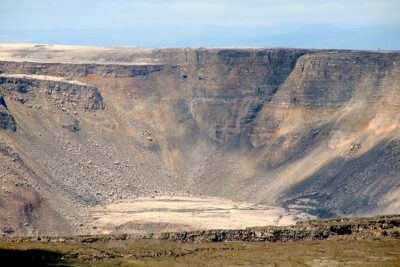
Small-Group Big Island Tour: Hawaii Volcanoes National Park and Kona Coffee Farm
Read our review →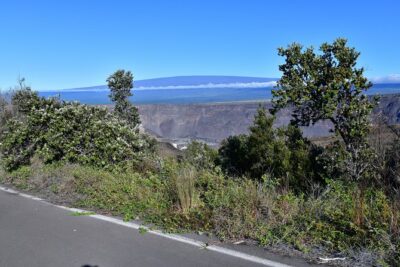
Private Tour: Hawaii Volcanoes National Park Eco Tour
Read our review →