
Reviewed · BAR HARBOR NATIONAL PARK TOURS
Milky Way Photography Workshop in Acadia National Park
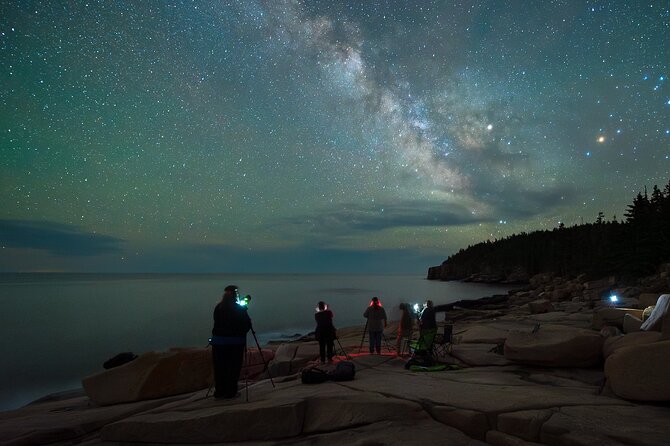
Acadia after dark gives you more than a sky full of stars. You’ll work with the Milky Way above rocky coastlines, quiet ponds, and familiar park sights that take on a very different look at night. Christopher leads the field sessions and teaches both camera technique and digital editing.
I like the small group limit of five, which gives you room to ask questions without losing the personal feel. I also like the mix of fieldwork and post-processing, since a good night photo often depends as much on careful editing as on finding a clear sky.
The main drawback is the price: $2,500 per person, before lodging, meals, and park admission. You also need suitable camera gear and enough stamina for late-night outdoor sessions.
Key points to know before booking
- Five-night-style days of instruction: The workshop lasts about five days, with photography sessions scheduled during evening and early-morning hours.
- Five Acadia locations: You’ll work at Jordan Pond, Otter Cliff, Bubble Pond, Sand Beach, and Eagle Lake.
- Christopher teaches the full process: Instruction covers planning, shooting, focus stacking, time-lapse work, Lightroom, and Photoshop.
- Private park transportation: All transport inside Acadia is provided, with water and snacks in the vehicle.
- Advanced techniques are part of the program: You’ll practice single exposures, stacked images, foreground exposures, and blended night scenes.
- You need serious equipment: Bring a DSLR or mirrorless camera, a fast wide-angle lens, a sturdy tripod, and an intervalometer if your camera does not include one.
Why Acadia works so well for night photography
Acadia gives you several strong foreground subjects within a compact national park. That matters because the Milky Way alone can make a nice image, but a pond, cliff, beach, or tree line gives the picture a sense of place.
This workshop focuses on celestial storytelling rather than simply pointing a camera upward. You’ll learn how to place the Milky Way in relation to the coast and park scenery, then use movement in the stars, water, rocks, and clouds to create a more deliberate composition.
The timing is unusual but practical. Available sessions run from 7:00 p.m. to 11:30 p.m. and again from midnight to 3:30 a.m., Tuesday through Saturday, during the listed operating period. You should expect late nights, interrupted sleep, and outdoor work in changing conditions. That schedule is not ideal for someone hoping for a relaxed sightseeing trip, but it gives night photographers the hours they need.
The workshop is offered in English, includes mobile ticketing, and provides pickup. The exact pickup details should be confirmed before you arrive in Bar Harbor.
More Photo Trips in Bar Harbor:
- Canyoning Bled Slovenia Triglav National Park Tour with Photos
★ 5.0 · 125 reviews - Hiking in Riisitunturi National Park with Photographer
★ 5.0 · 114 reviews - Bled: Triglav National Park Canyoning Adventure with Photos
★ 5.0 · 102 reviews
Jordan Pond: calm water and strong reflections
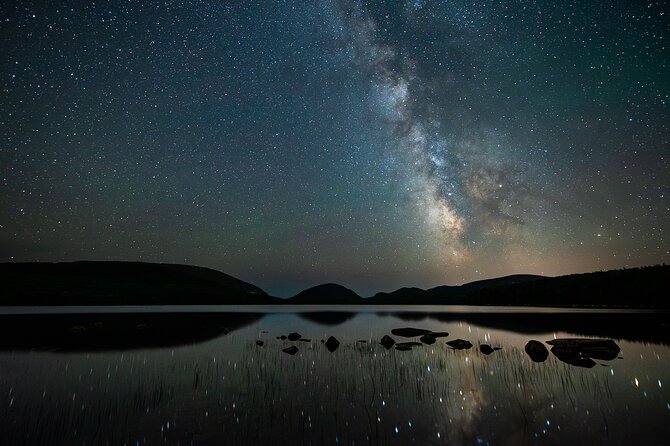
Jordan Pond is a useful place to begin thinking about foreground balance. The pond can provide a dark, reflective surface beneath the stars, while the surrounding shapes give you more than an empty black lower half in the frame.
Here you’ll work on the basic decisions that affect nearly every night image: focus, exposure, aperture, shutter speed, and composition. A fast wide-angle lens is important because it allows more light onto the sensor, while a sturdy tripod keeps the camera steady during long exposures.
Christopher’s instruction also covers the difference between a single exposure and a stacked image. A single exposure can be quick and direct. Stacking several frames can help reduce noise or create a stronger final image, but it requires more careful planning and later work on the computer.
Jordan Pond is likely to appeal most if you want a quieter setting for learning. The tradeoff is that a pond scene can look simple if the composition is not carefully planned. That is where the PhotoPills app becomes useful.
Planning the Milky Way with PhotoPills
A key part of the course is using PhotoPills to plan where and when the Milky Way will appear in relation to your subject. This is one of the most useful skills you’ll take home because it applies far beyond Acadia.
Instead of arriving and hoping the stars line up, you can check the position and movement of the Milky Way before the shoot. That helps you decide where to stand, which direction to face, and how much of the frame should be sky.
The planning stage also supports the workshop’s focus on storytelling. You might frame the galaxy over a pond, along a cliff, or above a beach rather than treating it as a separate subject. Good night photography often begins before you leave your lodging.
The course assumes you already understand basic manual camera settings and some post-processing. If you are new to changing shutter speed, aperture, ISO, and manual focus, you may find the pace demanding. Christopher can guide you through advanced methods, but this is not presented as a first-ever camera class.
Otter Cliff: dramatic coastal structure after dark
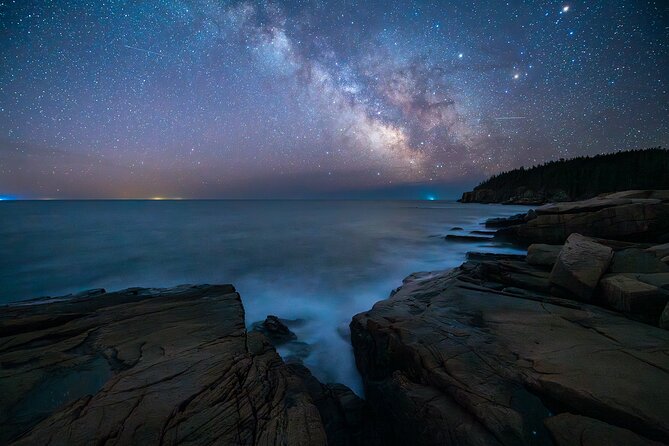
Otter Cliff supplies the bold coastal setting promised by the workshop. Rock, sea, and sky create a stronger sense of drama than a plain star field, and the location supports the course’s goal of combining celestial motion with coastal forms.
This is where foreground technique becomes especially important. You may make one exposure for the stars and another, longer exposure for the foreground, then blend them in Photoshop. That approach can preserve detail in both the night sky and darker rocks without forcing one exposure to handle every problem.
The method takes practice. The camera must remain fixed, and you need to pay attention to focus, framing, and changes in light between exposures. The resulting file may look more polished than a quick single shot, but you also spend more time editing.
The coast brings a practical concern: conditions can change, and the workshop requires good weather. You should bring clothing and footwear suited to late-night outdoor work, although the supplied information does not list a specific clothing requirement.
More Hands-On Sessions in Bar Harbor:
- Denali Alaska: Wilderness Rafting Class II-III Trip
★ 4.8 · 32 reviews - Tenerife: Scuba Diving Lesson and Abades Protected Area Dive
★ 5.0 · 17 reviews - Canyon Run: Denali National Park Class IV Whitewater Rafting
★ 4.2 · 16 reviews
Bubble Pond: a chance to study reflections and star movement
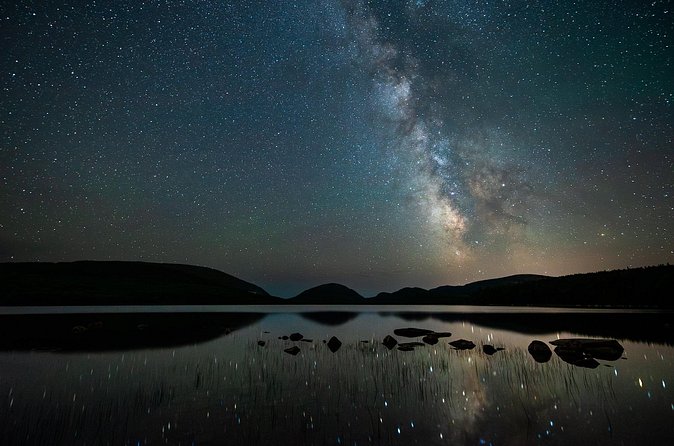
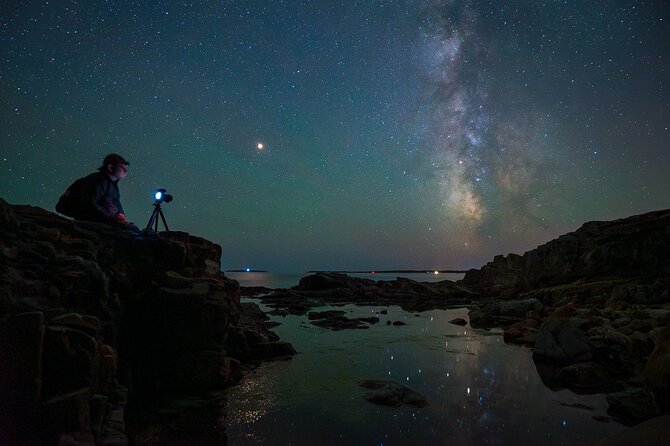
Bubble Pond adds another water-based setting, but it gives the workshop a chance to approach the same subject in a different way. Reflections, tree shapes, and open sky can help you build depth from front to back.
You’ll also work with star trails and time-lapse ideas. One past participant produced time-lapse sequences showing clouds and stars moving over time, and Christopher teaches the related camera and processing steps. This is a useful bonus if you want to move beyond still photos.
Time-lapse work requires patience and careful setup. The camera needs to remain in place for a series of exposures, and the files later need to be processed into a video or sequence. You should not expect every technique to produce a finished result immediately, especially if you are new to interval shooting.
Bubble Pond may be one of the better places to think about quiet, layered compositions. The setting is less about a single dramatic object and more about how water, trees, sky, and motion work together.
Sand Beach: a wider, more open composition
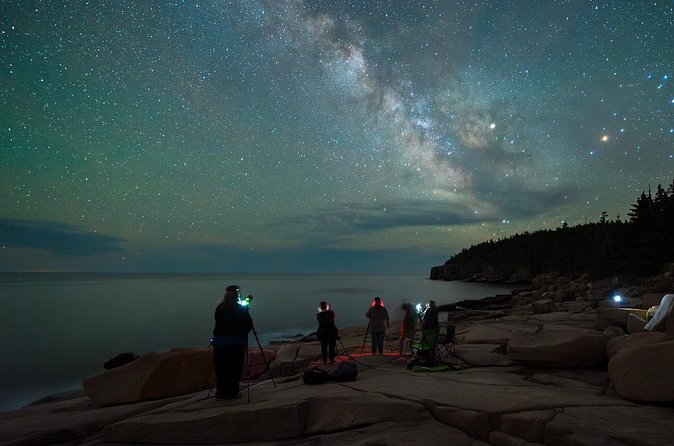
Sand Beach changes the visual rhythm of the workshop. The open shore can give you a broad sweep of sky and a clean foreground, making it easier to emphasize the Milky Way’s shape and position.
This is also a good setting for learning how foreground elements add scale. A beach image can feel spacious, but it can also become empty if you do not place something in the lower part of the frame. Christopher’s teaching focuses on making the foreground part of the story, not an afterthought.
You’ll continue practicing exposure choices here. A wide-angle lens with an aperture of f/2.8 or faster is required, and that requirement is important rather than cosmetic. A faster lens can gather more light during short star exposures, which helps keep stars sharp and reduces the need for extreme camera settings.
Sand Beach is also one of the places where weather matters most. Cloud cover can hide the Milky Way, while changing conditions can still create interesting images. Since the workshop may be rescheduled or refunded if poor weather cancels it, you should leave flexibility in your travel plans.
Eagle Lake: finishing with composition and technique
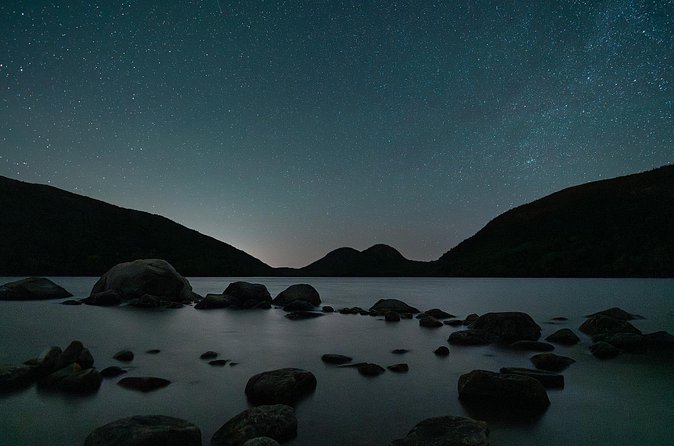
Eagle Lake completes the listed route with another setting where water and sky can work together. By this point, you’ll have had several chances to compare different foregrounds and decide how much attention each image should give to the stars.
The value of visiting several locations is not simply collecting more photo stops. You can test the same technique in different settings and see what changes. A method that works at a cliff may need different framing at a pond or beach.
The workshop also encourages focus stacking, a method that can help keep both near and distant parts of a scene sharp. This is especially useful when you want a foreground object to look crisp while also recording the stars at a different focus distance.
The five locations provide variety, but you should not treat the itinerary like a standard sightseeing tour. The purpose is to spend time setting up, checking focus, making multiple exposures, and learning. You may photograph fewer final images than you would on a fast-moving park tour, but the images should have more thought behind them.
The classroom work matters as much as the night shoots
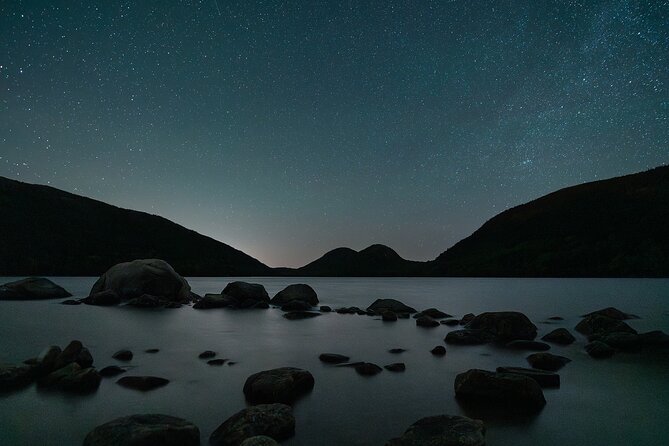
The strongest part of this program is the connection between field technique and editing. You’ll work in Lightroom and Photoshop, including workflows for blending exposures and improving night images.
A useful example is the two-exposure method for a Milky Way image. One frame records the sky, while another records a longer foreground exposure. You then combine them in Photoshop. The goal is not to create an artificial scene, but to handle the limits of a single camera exposure.
You’ll also learn about focus stacking and time-lapse processing with third-party software. These skills extend beyond astrophotography and can help with other forms of outdoor photography.
The included one-on-one post-processing session via Discord adds real value. It gives you a chance to ask about your own files after the field portion is over. That follow-up is particularly useful because editing problems often appear only when you begin working through a full set of images.
Christopher’s teaching style is described as calm, patient, warm, and easy to spend time with. Those qualities matter in a technical workshop. Night photography involves waiting, repeated adjustments, and occasional mistakes, so an instructor who explains the process without rushing you can make a major difference.
What the $2,500 price really covers
At $2,500 per person, this is a serious investment. You are paying for roughly five days of instruction, private transportation inside Acadia, a maximum group size of five, field guidance, snacks and water, and the follow-up editing session.
The small group is central to the value. With only five participants, Christopher can help with camera setup and composition in the field. A larger group might cost less, but you could spend more time waiting for help or trying to follow a demonstration from a distance.
The price does not include lodging, meals, or park admission. That means your total trip cost will be higher, especially if you stay in Bar Harbor for the full workshop period. Lodging and food are also your responsibility, so budget for those separately.
The supplied information lists a $20 entrance fee and asks for a valid Yellowstone National Park pass, which does not match an Acadia National Park workshop. Treat that as something to verify directly before booking. Do not assume a Yellowstone pass is the correct admission document for Acadia.
For the right person, the cost can make sense. If you already own the required equipment and want direct help with advanced night photography, the private transport and personal instruction may be worth more than a general park tour. If you are new to manual photography or mainly want a casual look at the stars, a less expensive outing may suit you better.
Equipment, fitness, and late-night comfort
You need:
- A DSLR or mirrorless camera capable of long exposures
- A wide-angle lens with an aperture of f/2.8 or faster
- A sturdy tripod
- An external intervalometer, unless your camera has one built in
- Basic knowledge of manual settings and post-processing
The equipment list rules out a phone-only approach. You can bring additional lenses if you have them, but the required wide-angle lens is the key item for Milky Way work.
A moderate level of physical fitness is required. The supplied details do not specify distances or trail difficulty, so ask for more information if walking or standing outdoors at night is a concern.
Service animals are allowed. Pickup is offered, and transportation within Acadia is private. Water and snacks are provided in the vehicle, but meals are not included.
Who will get the most from this workshop
I would choose this for a photographer who already knows the basics and wants to improve night work in a real setting. It is especially well suited to someone who wants to learn how to plan a shoot, make multiple exposures, blend files, and create time-lapse sequences.
It also suits repeat learners. One participant returned three times and used the workshop to build skills in Milky Way photography, panoramas, multiple exposures, cloud and star time-lapse work, and editing. That suggests the program can support different levels of ambition, though the required foundation remains important.
I would be cautious about booking it for children or anyone who dislikes late nights, outdoor waiting, or technical instruction. The 12:00 a.m. to 3:30 a.m. window is demanding, and clear skies cannot be guaranteed.
The weather policy helps reduce some risk. If conditions cancel the experience, you can receive a different date or a full refund. If the minimum number of participants is not reached, the same options apply. For your own cancellation, you must cancel at least 24 hours before the start time for a full refund.
Should you book the Acadia Milky Way workshop?
Book it if you already have a capable camera kit, understand manual exposure, and want focused help creating finished astrophotography images. The best reasons to choose it are the five-person limit, Christopher’s patient instruction, private park transport, and the included editing session after the fieldwork.
Think twice if you want a simple evening under the stars or if the $2,500 fee would strain your trip budget. You’ll also need to pay for lodging, meals, and admission, and you should confirm the confusing park-pass information before paying.
For a serious photographer, this is less a sightseeing tour than a compact working course in Acadia. You leave with more than a few star photos: you learn how to plan the sky, build a foreground, control multiple exposures, and finish the image properly.
FAQ
How long does the workshop last?
The workshop lasts approximately five days.
Where does the workshop take place?
It takes place in and around Acadia National Park, with Bar Harbor listed as the location.
Which places will I photograph?
The listed stops are Jordan Pond, Otter Cliff, Bubble Pond, Sand Beach, and Eagle Lake.
What camera do I need?
You need a DSLR or mirrorless camera capable of making long exposures.
What lens should I bring?
You need a wide-angle lens with an aperture of f/2.8 or faster.
Do I need a tripod?
Yes. A sturdy tripod is required.
Do I need an intervalometer?
You need an external intervalometer unless your camera has one built in.
Is transportation included?
Yes. Private transportation is provided for travel within Acadia National Park, and pickup is offered.
Are meals and lodging included?
No. Meals and lodging are not included. Water and snacks are provided in the transport vehicle.
What happens if bad weather cancels the workshop?
You’ll be offered a different date or a full refund if poor weather causes the experience to be canceled.
Newest park tours we have reviewed in Bar Harbor
- Acadia National Park & Bar Harbor Self-Guided Driving & Walking Tour★ 4.5 · 66 reviews
- Self-Guided Audio Driving Tour in Acadia National Park★ 4.5 · 46 reviews
- Acadia National Park Premium Specialized E-Bike Rental★ 5.0 · 8 reviews
- Acadia National Park Self-Guided Audio Tour★ 4.0 · 2 reviews
- Acadia National Park Tour Sea to Summit★ 5.0 · 2 reviews
- Bar Harbor: Acadia National Park Tour with Lobster Roll★ 4.6 · 38 reviews
- Bar Harbor: Acadia National Park Private Tour with Lunch★ 5.0 · 12 reviews
- Bar Harbor: Acadia National Park Customizable Private Tour★ 4.7 · 8 reviews
Bar Harbor National Park Tours, compared.
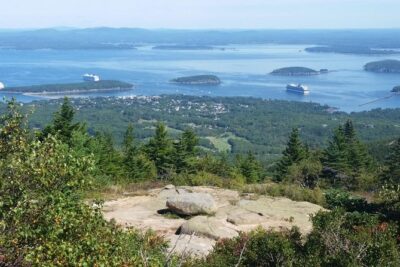
Narrated Bus Tour of Bar Harbor and Acadia National Park
Read our review →
Premium Narrated Bus Tour of Bar Harbor and Acadia National Park (3.5 Hours)
Read our review →
Ultimate Acadia National Park Self-Guided Driving Audio Tour
Read our review →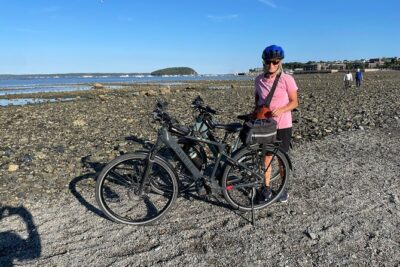
Self-Guided Ebike Tours of Acadia National Park Carriage Roads
Read our review →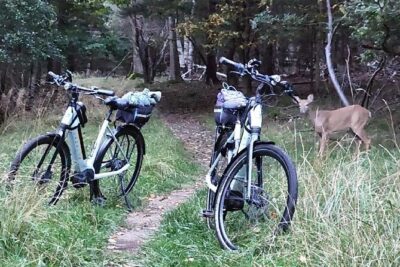
Guided Ebike Tour of Acadia National Park Carriage Roads
Read our review →
6 Hour: Premiere & Private Acadia National Park with Lobster Pier
Read our review →
Bar Harbor Premium Tour with Cadillac Mountain and Acadia Park
Read our review →
Acadia National Park & Bar Harbor Self-Guided Driving & Walking Tour
Read our review →Lists this park day appears in