
Reviewed · BANFF NATIONAL PARK TOURS
Banff: Guided Sunset and Stargazing Tour
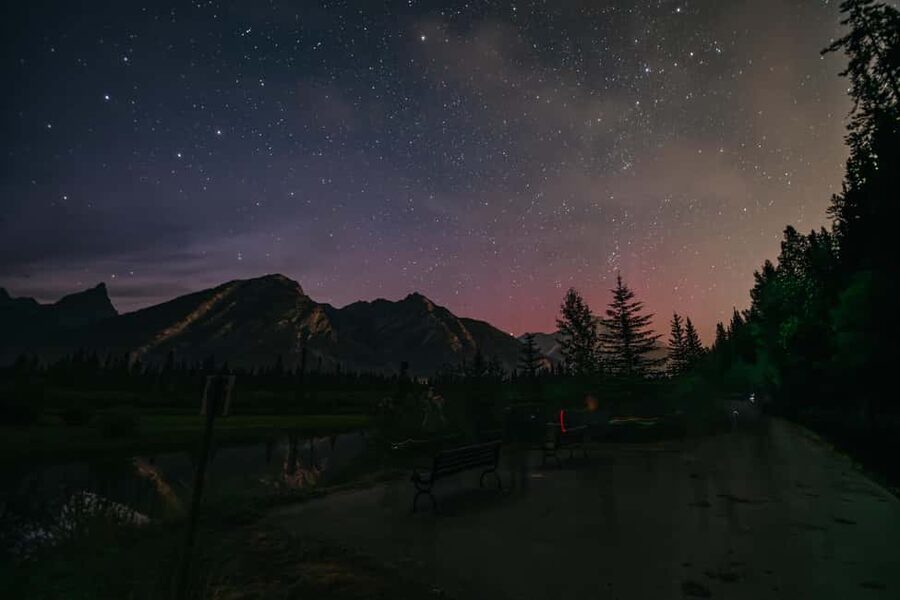
Banff changes character after sunset. On this guided walk from the Cave and Basin area, you follow quiet trails as the last light fades, then stop to pick out constellations, satellites, shooting stars, and perhaps the Northern Lights. It is part easy hike, part astronomy lesson, and part nighttime wildlife outing.
I like two things here: the walk is mostly flat and often paved, so you can enjoy the dark without tackling a hard mountain route, and the guides make the sky easier to read. Guides including Jacob, Ben, Ewan, Isla, and Kale have helped people find constellations and adjust phone settings for night photos.
The main catch is simple: the sky controls the show. Clouds, smoke, moonlight, and mosquitoes can reduce the stargazing. The company cancels in heavy cloud cover, but even a clear night can bring a bright moon or forest-fire haze.
Key points to know before you book
- A five-kilometre night walk: Expect roughly 3 to 3.5 miles on paved paths, boardwalks, and some dirt trail.
- Departure time changes by season: You receive the final start time 12 to 24 hours before departure, usually just after sunset.
- The guides are a major part of the value: They explain stars, local wildlife, Banff history, and safety in an easygoing way.
- Northern Lights are possible, not promised: Clear skies matter more than any advertised aurora hope.
- Night photography is part of the fun: Guides may help you use phone night mode or long exposure settings.
- No hotel transfer or refreshments: Meet at the Cave and Basin parking lot and bring water and suitable hiking shoes.
What this Banff night walk is really like
This is not a drive to a remote viewpoint followed by ten minutes of star watching. You walk through the evening, watching Banff shift from daylight to darkness. That gradual change is the heart of the outing.
The route covers about 5 kilometres, or roughly 3 to 3.5 miles. It is described as mostly paved, with boardwalks and dirt sections mixed in. Several people found it flat and easy, with benches at longer stops and no steep climbs. You still need to be comfortable walking that distance in the dark, at a steady outdoor pace.
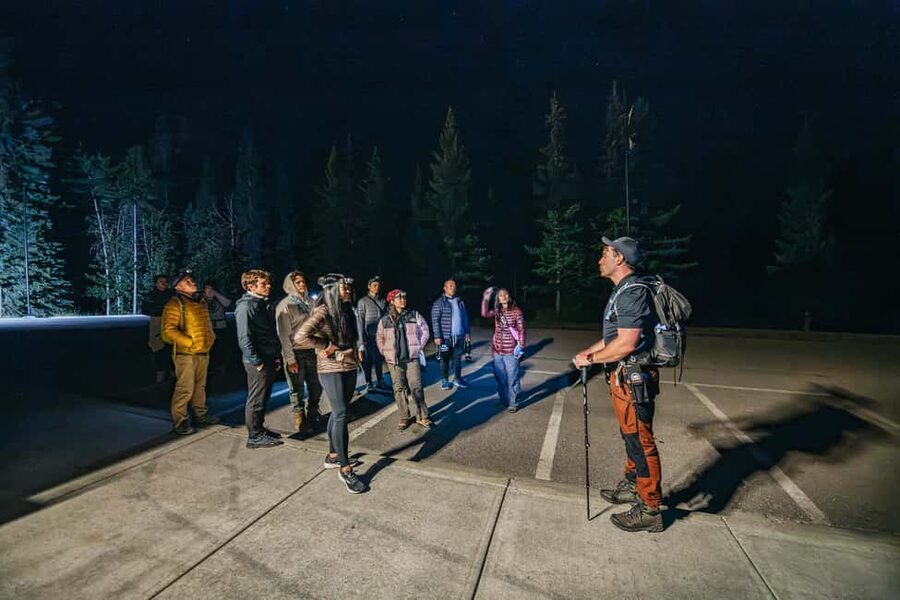
Your guide carries bear spray and other safety equipment. Headlamps and lanterns are provided, and ice cleats are available when conditions require them. That equipment matters in a national park, especially once the last daylight disappears. The guide also keeps the group together and watches for wildlife.
You should not expect a silent, solitary walk. The guide talks throughout much of the route, mixing astronomy with stories, local history, and practical safety advice. One guide even kept up a steady stream of conversation as a way to make the group’s presence known to bears. It is a funny detail, but it also explains why this is better done with a professional guide than alone.
More Banff and Jasper National Park Tours in Canada:
- Jasper National Park: Maligne Lake Cruise With Guide
★ 4.7 · 896 reviews - Explore Banff National Park with Our Premium Day Tour
★ 5.0 · 777 reviews - Banff National Park Tour with Lake Louise and Moraine Lake
★ 4.5 · 692 reviews
Starting at Cave and Basin after sunset
You meet outside the Welcome Building at the Cave and Basin National Historic Site parking lot, at 309 Cave Ave. The parking lot is large and free, but there is no hotel pickup or drop-off, so you need to make your own way there.
Bring your voucher and look for the guide holding a clipboard. The final start time is seasonal because the walk begins around sunset. The operator contacts you 12 to 24 hours before departure with the updated time, so check your messages on the day before the tour.
The Cave and Basin setting gives the evening a useful sense of place. You are not starting from a generic roadside meeting point. You are beginning near one of Banff’s best-known historic areas, then heading onto local trails as the light softens.
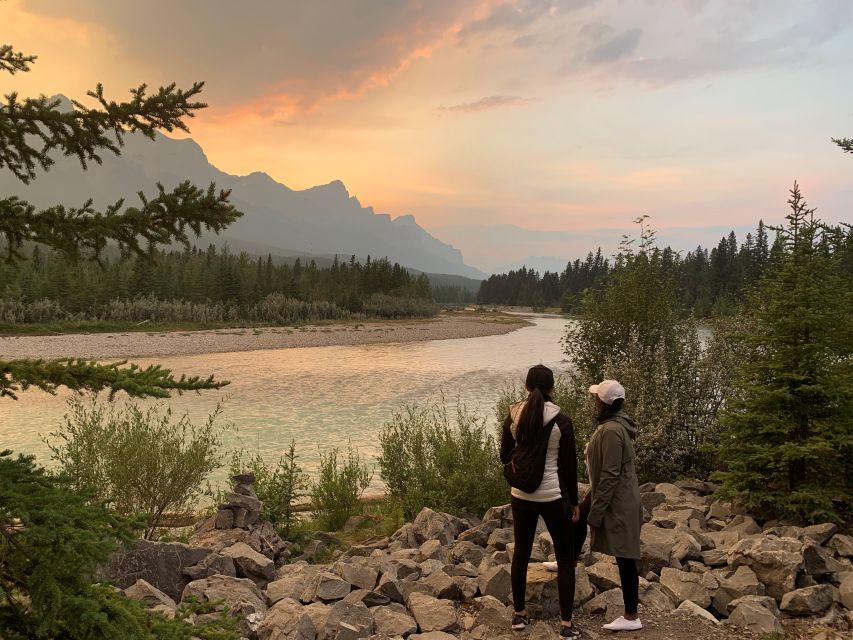
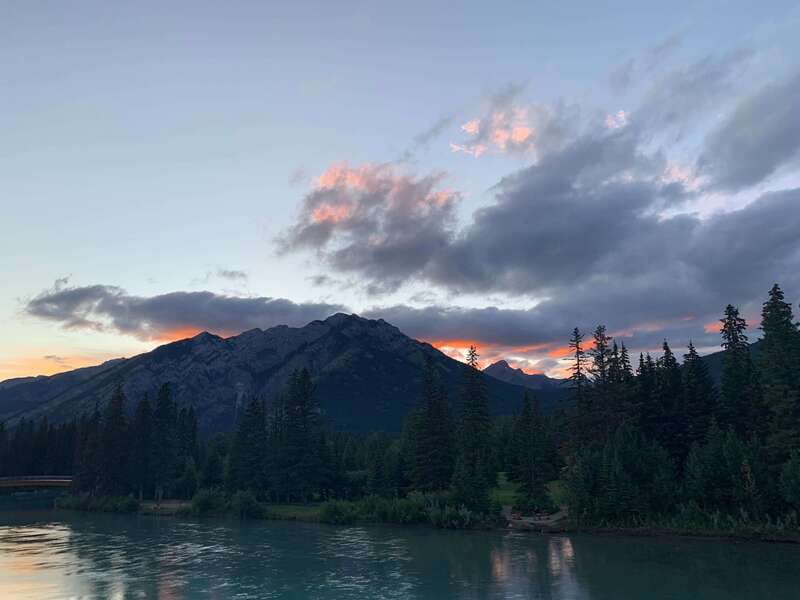
At the start, you may still have enough daylight to see the surrounding mountains and water clearly. That early part is often the best time for broad scenery and photographs. As the sun drops, the focus shifts from mountain views to the sky overhead.
Sunset views before the headlamps come out
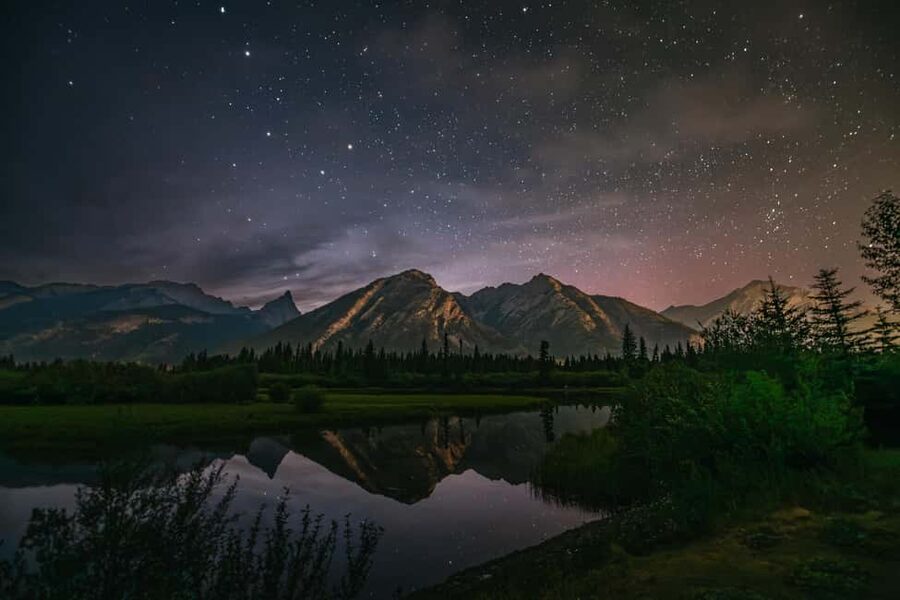
The first part of the route is guided sightseeing in the changing light. You can expect scenic views along the way, with the sunset forming a natural opening to the night walk.
The timing is important. If you booked this as a standard evening stroll, the changing departure hour may seem inconvenient. In practice, it is what lets you see the sunset and then the first stars without waiting around for darkness. The company adjusts the departure seasonally rather than using one fixed hour all year.
This is also when you can get your bearings. In daylight, the trail feels like an ordinary Banff walk. Once the group turns back or moves farther into the dark, the same path feels much more atmospheric. Headlamps become useful, but the guides may ask you to limit unnecessary light during viewing stops.
The walk does not promise a dramatic sunset every time. Clouds can mute the colours, and smoke can soften the mountain views. Still, the transition from blue evening light to a black sky gives the outing its structure, even when the stars do not fully cooperate.
Reading the sky with Jacob, Ben, Ewan, and the team
The strongest part of the tour is the guide. You are not simply pointed toward the sky and left to guess what you are seeing.
Guides have explained constellations, local mountain features, Banff history, hot springs, wildlife, and night-sky photography. Jacob has been praised for mixing stories and jokes with clear explanations. Ben has helped people use iPhone night mode and has added background about the area. Ewan has assisted with camera settings when smoke affected visibility.
Other named guides include Kale, Kael, Isla, Ila, Yuin, and Ian. Names and assignments change, but the pattern is consistent: expect an English-speaking guide who keeps the group engaged and checks that everyone is keeping up.
That personal attention can make a big difference. One guide slowed the pace when a participant was struggling, allowing the whole group to stay together. Another helped a solo participant feel included. If you are nervous about walking near wild animals, the guide’s safety briefing and awareness of the surroundings should make the night feel more manageable.
Do not expect an academic astronomy lecture. The tone is lively and accessible. You learn enough to recognize several stars and constellations, then return home with a better sense of how to find them yourself.
More Guided Trips in Canada:
- Quebec City: Guided Hike in Jacques-Cartier National Park
★ 4.6 · 224 reviews - Banff National Park Guided Hike with Lunch
★ 5.0 · 200 reviews - From Toronto: Bruce Peninsula National Park Guided Day Trip
★ 4.4 · 152 reviews - Banff National Park: Guided Signature Hikes with Lunch
★ 4.9 · 123 reviews
Stars, satellites, shooting stars, and the Northern Lights
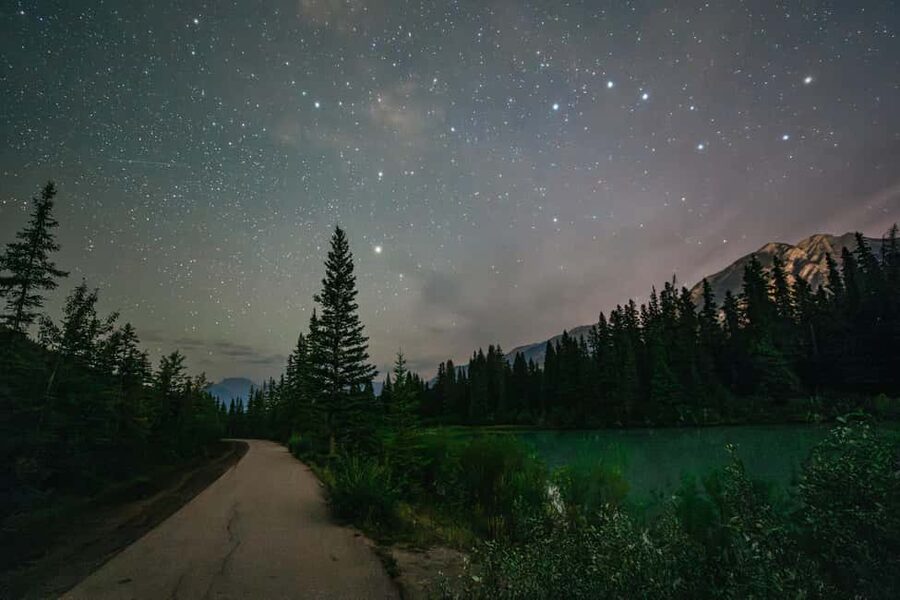
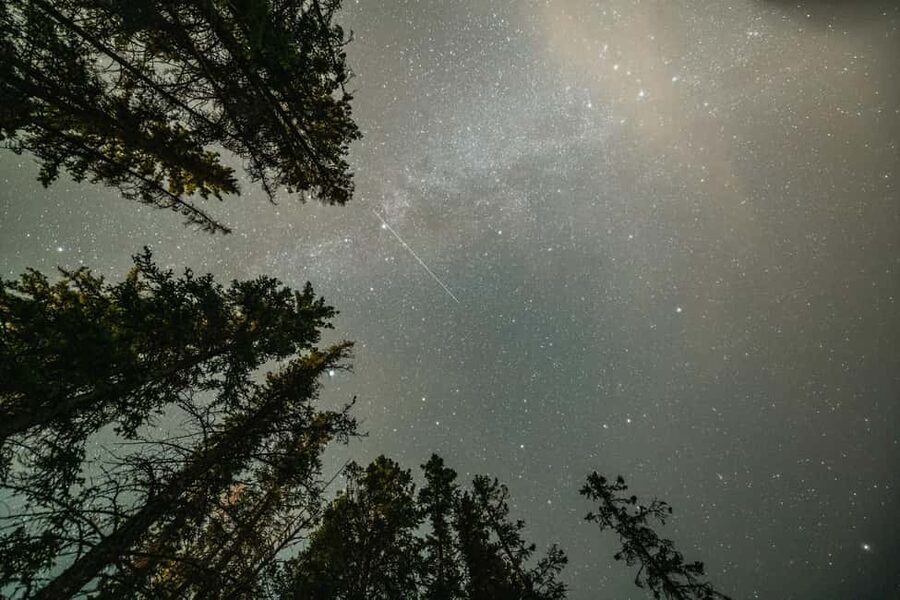
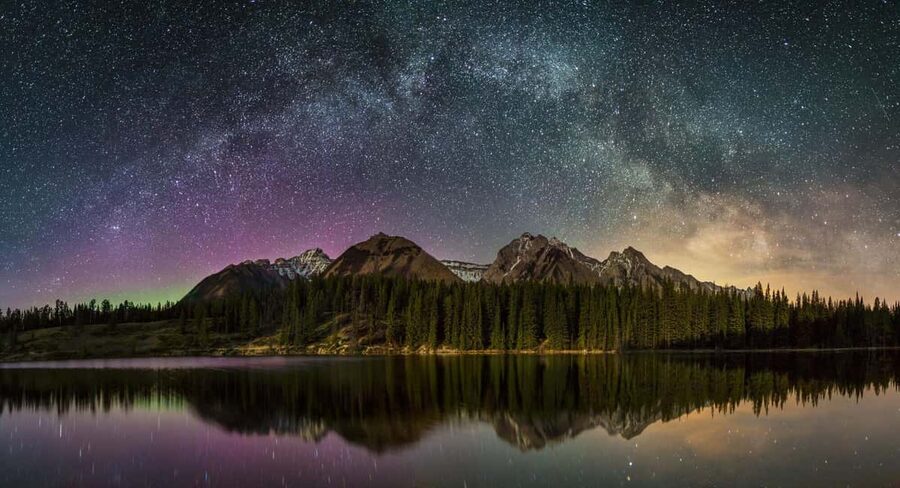
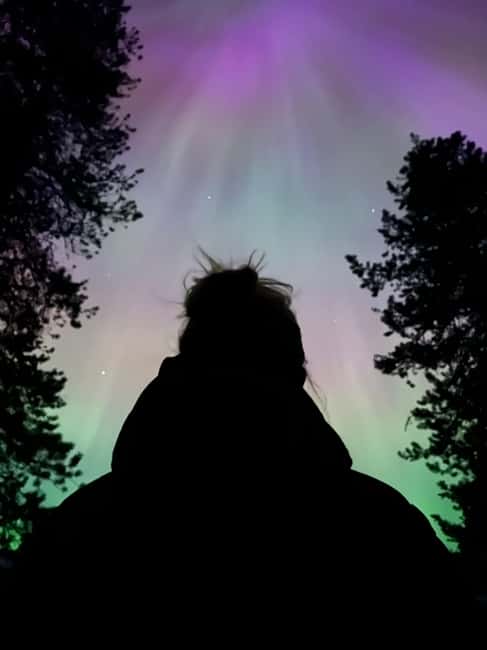
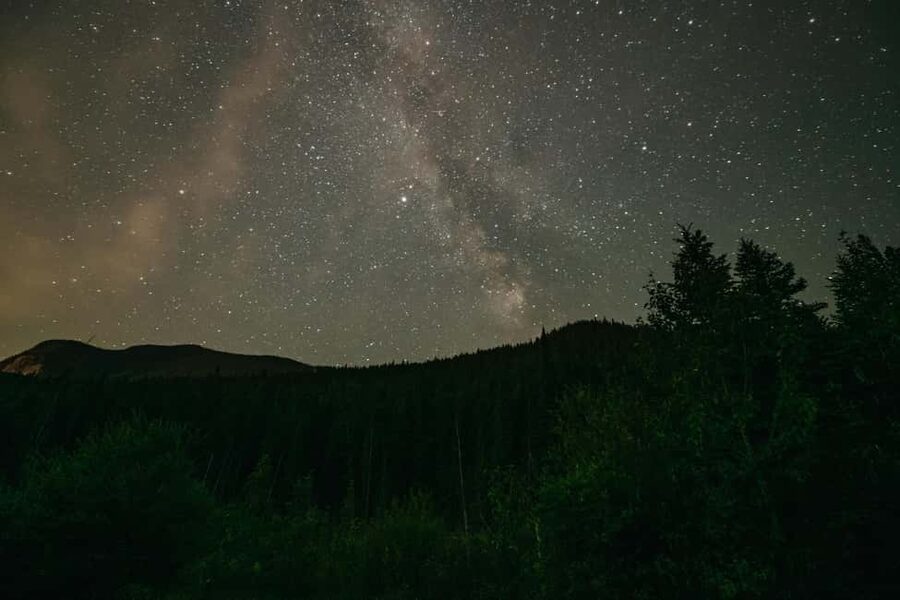
On a clear night, the sky is the main event. You may see constellations, satellites, shooting stars, meteors, and the Milky Way. One outing included a comet, while another caught a coyote along the way. The Northern Lights have also appeared during some departures.
That list is exciting, but none of it is guaranteed. Aurora activity changes quickly, and shooting stars are a matter of timing. The Milky Way needs dark, clear conditions. A nearly full moon may brighten the sky enough to wash out fainter stars, while wildfire smoke can reduce visibility even when there are no clouds.
The company does not operate in heavy cloud cover. If poor conditions are expected, the guide contacts the group 12 to 24 hours before departure and issues refunds. This is a sensible policy for a stargazing tour, and it prevents you from spending two hours staring at an entirely covered sky.
Still, do not treat cancellation as the only sign of a bad night. Some departures have had light cloud, smoke, or a bright moon and still produced a worthwhile walk with visible constellations. The guide can point out stars through gaps in the cloud and explain what you would normally see under darker conditions.
If your top goal is the Northern Lights, keep your expectations modest. This tour gives you a chance to see them, but it is not an aurora guarantee or a dedicated chase.
Night photography with a phone
You do not need a professional camera. Guides have helped people change phone settings, use night mode, and take long-exposure photos of the stars and mountains.
A phone will not reproduce every detail your eyes see, but the help is useful. Many people know their camera has a night setting but do not know when to use it or how long to hold the phone steady. A guide can offer practical advice at the viewing stops.
Bring your phone fully charged. This is sensible advice for any evening outing, especially when the device is also your camera and may be used as a light. The supplied headlamps mean you do not need to rely on the phone flashlight for the walk.
The best photo opportunities can come before full darkness, when the mountains, water, and deep blue sky still show detail. Later, you may get better star photos. If the Northern Lights appear, the guide may help you adjust the phone to capture them.
Wildlife, safety, and the real feel of walking in the dark
Banff’s nocturnal world is part of the appeal. The tour encourages you to look for animals using headlamps and lanterns, but it does not promise a wildlife sighting. You might see something as small as movement in the trees or as memorable as a coyote.
The important point is that wildlife is treated as a safety matter, not entertainment at any cost. Guides carry bear spray and other equipment, monitor the group, and keep an eye on possible animal activity. You should follow their instructions, stay with the group, and avoid bringing food or alcohol onto the walk.
Bugs are worth planning for in warm months. Mosquitoes have been especially noticeable early in some summer walks, so bring insect repellent if you have it. A guide may have bug spray available, but it is better not to depend on that.
The trail itself is easier than the setting may suggest. Much of it is paved or on boardwalk, and some sections are dirt. It is not a technical hike, but darkness changes the experience. You need hiking shoes, steady footing, and enough stamina for the full distance.
The activity is listed as wheelchair accessible, but it is also described as unsuitable for people with mobility impairments, recent surgery, certain medical conditions, and pregnant women. If accessibility is important for your booking, ask the operator about the current route and conditions before paying.
Is 66 Canadian dollars good value?
At $66 per person for two hours, this is reasonably priced for a guided evening in Banff. You are paying for a professional guide, headlamps, seasonal ice cleats, route planning, and safety equipment. You are also getting instruction that is difficult to replicate on your own, especially if you do not know the night sky or local trails.
The value is strongest on a clear night, when you see many stars and perhaps the Milky Way, a meteor, or the Northern Lights. It remains fair on a partly cloudy evening because the walk, local stories, wildlife discussion, and sunset still provide structure.
It is less satisfying if you want a guaranteed spectacle. You may encounter a bright moon, haze, mosquitoes, or cloud gaps that limit the stars. The free cancellation policy, with a full refund up to 24 hours before departure, reduces some of that risk. The reserve-now-pay-later option also keeps your plans flexible.
For the price, I would see this as a good add-on to a Banff visit, not a replacement for a full daytime national park outing. The night walk offers a different view of the area and does not require a full day or a large budget.
Who should book this evening tour?
I would recommend it to adults and children aged eight or older who enjoy easy walking, nature, and a bit of uncertainty. It works well for couples, solo visitors, small groups, and anyone who wants an evening activity beyond restaurants and town streets.
It is especially useful for first-time stargazers. You do not need to know Orion from the Big Dipper before you arrive. The guide gives you enough context to make the sky less confusing, and the photography tips can help you take home more than a dark blur.
You should think twice if you dislike walking three miles, feel uneasy outdoors after dark, or need a rigid schedule. The departure time changes seasonally, weather can cancel the tour, and the full experience depends heavily on the sky.
My verdict: book it for the night, not just the aurora
Book this tour if you want an easy, guided way to see Banff after sunset. The five-kilometre route is manageable, the guides add real value, and the combination of sunset, stars, wildlife awareness, and local stories feels more memorable than a standard evening walk.
Do not book it only because you expect Northern Lights. Choose a clear forecast, check the moon phase if stargazing matters to you, bring warm layers and hiking shoes, and pack mosquito repellent in summer. If the sky cooperates, $66 can buy one of the most memorable evenings of your Banff visit. If it does not, you still get a safe introduction to the park at night.
FAQ
Where does the Banff sunset and stargazing tour begin?
Meet outside the Welcome Building at the Cave and Basin National Historic Site parking lot, at 309 Cave Ave. The lot is large and has free parking.
How long is the tour?
The tour lasts two hours and covers about 5 kilometres, or roughly 3 to 3.5 miles.
What time does the tour start?
The departure time changes seasonally and is usually just after sunset. You receive the updated time 12 to 24 hours before departure.
Is the Northern Lights display guaranteed?
No. The Northern Lights are possible but not guaranteed. Clear skies are needed for the best chance of seeing them.
What happens if the weather is cloudy?
The tour does not operate in heavy cloud cover. If this is expected, the guide contacts you 12 to 24 hours before departure and issues a refund.
What equipment is included?
A professional guide and headlamps are included. Ice cleats are also provided when required.
What should I bring?
Bring hiking shoes. You should also consider warm clothing and mosquito repellent, especially during warmer months.
Is the tour suitable for children and people with mobility concerns?
Children under eight are not permitted. The activity is not suitable for pregnant women, people with mobility impairments, certain pre-existing medical conditions, or recent surgery.
Newest park tours we have reviewed in Canada
- From Banff: Snowshoeing Tour in Kootenay National Park★ 4.9 · 37 reviews
- From Jasper: Jasper National Park Wildlife Discovery Tour★ 4.4 · 86 reviews
- Jasper: Winter Wildlife Bus Tour in Jasper National Park★ 4.6 · 93 reviews
- Private Banff and Yoho National Park Tour with Moraine Lake★ 5.0 · 17 reviews
- From Calgary: Banff & Yoho National Parks Private Day Tour★ 4.8 · 19 reviews
- Banff National Park & Lake Louise FULL DAY PRIVATE TOUR★ 5.0 · 50 reviews
- PRIVATE Wilderness and Wildlife Walking Tour – 3hrs★ 4.9 · 17 reviews
- Banff National Park: Guided Signature Hikes with Lunch★ 4.9 · 123 reviews
Banff National Park Tours, compared.
Banff National Park Tour with Lake Louise and Moraine Lake
Read our review →
Banff National Park: 1-Hour Bow River Horseback Ride
Read our review →
Banff National Park: 1-Hour Spray River Horseback Ride
Read our review →
Banff National Park: Big Canoe River Explorer Tour
Read our review →
Banff and Jasper National Parks: Tour with Transport
Read our review →
River Explorer | Big Canoe Tour in Banff National Park
Read our review →Lists this park day appears in