
Reviewed · NATIONAL PARKS
Jiuzhai Valley National Park:Visit Colorful Fairy Tale World
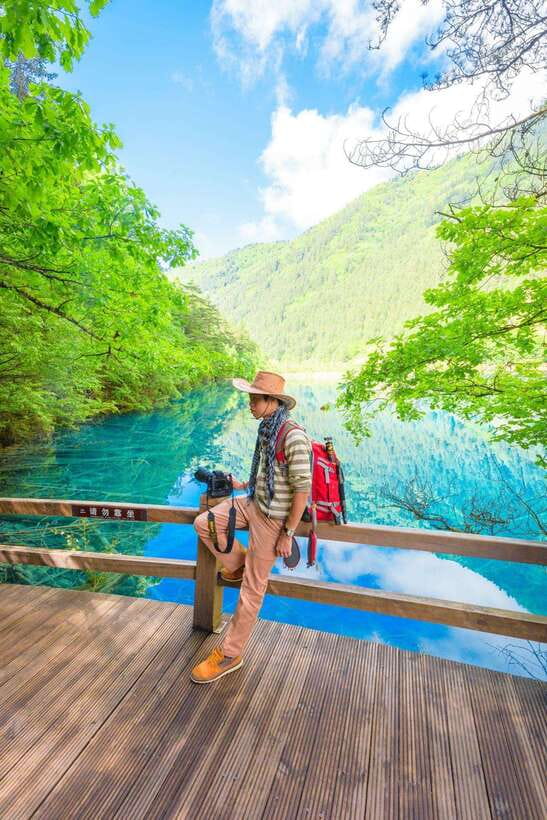
Jiuzhai Valley is the sort of place that makes a camera feel inadequate. More than 114 lakes shine between forests and sharp mountain forms, with water so clear and richly colored that the park can look painted rather than real. I especially like the well-built paths and the included sightseeing bus, which let you cover a large area without turning the day into one long uphill march. I also like that you can see more than scenery here: nine Tibetan villages still give the valley its name and cultural identity.
The catch is simple: one day is tight. A summer visit can be crowded enough to slow your walking pace, and one person who spent a full day in the park had not reached half of it. Think of this as a high-value introduction, not a complete exploration. If you want quiet paths, long walks, or every major lake, plan extra time if your schedule allows.
Key things to know before you book
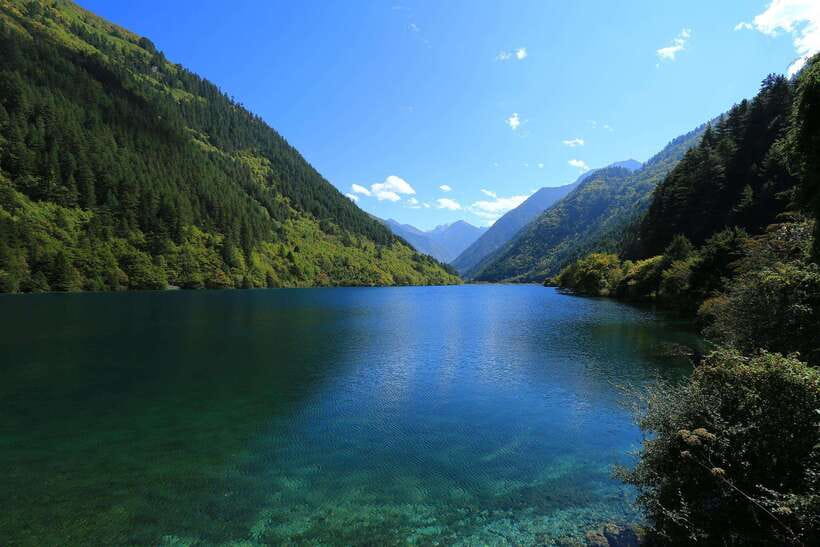
- 114-plus colorful lakes: Jiuzhai Valley is known for blue and green water, with many separate lakes spread across a large mountain park.
- Sightseeing buses save your legs: The included park bus helps you move between scenic areas instead of walking the entire route.
- Tiered waterfalls are a major draw: Clear water drops through several levels, giving the park some of its most memorable views.
- One day covers only a portion: The park stretches across about 720 square kilometers, so you need to choose your stops wisely.
- Tibetan culture adds depth: Nine Tibetan villages remain connected to the valley, and local music and dance may be part of the cultural experience.
- Basic support is strong: Toilets, food and drink stalls, Chinese and English assistance, and WhatsApp communication help keep the day manageable.
Why Jiuzhai Valley looks almost unreal
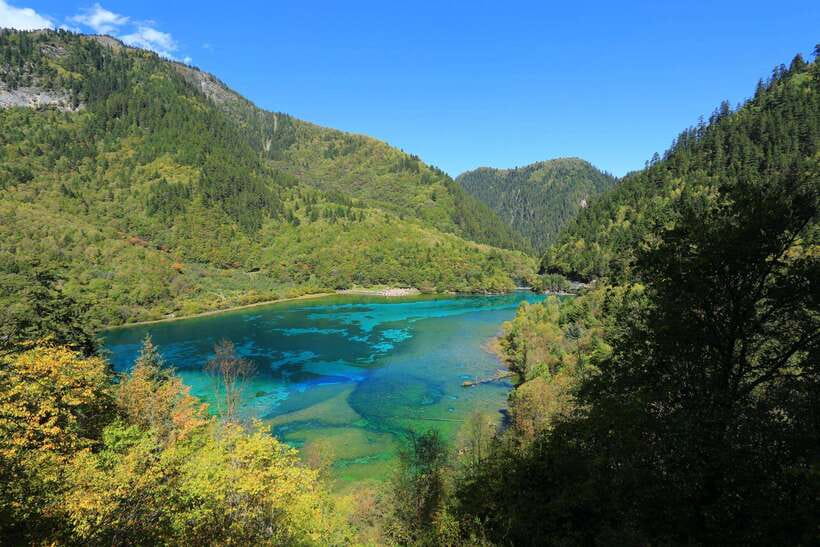
Jiuzhai Valley, also called Jiuzhaigou, lies in the Min Shan mountain range of northern Sichuan, on the edge of the Tibetan Himalayan Plateau. Its name means Nine Village Valley, referring to the Tibetan villages scattered through the park.
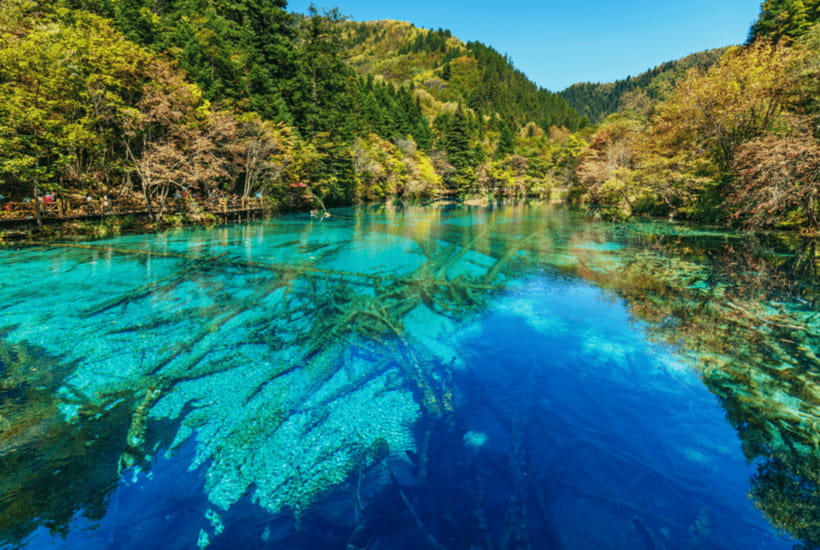
The water is the star. You will find more than 114 individual plateau lakes, each with its own mix of blue, green, and clear shallows. The color changes with depth, mineral content, light, and the forest around it. The result is not one grand viewpoint, but a long chain of changing scenes.
The park also has narrow, cone-shaped karst formations and a series of waterfalls. Some falls are broad and gentle, while others drop in several levels through the trees. The water is remarkably clear, and the combination of moving water, mountain forest, and sharp rock gives the valley its famous fairy-tale quality.
The setting changes with the seasons. Autumn brings strong color to the forests. Winter covers the area in snow and gives the waterfalls and lakes a colder, quieter appearance. Summer offers full greenery and easier access, but it is also the time when crowds can make the paths feel slow.
Jiuzhai Valley covers about 720 square kilometers, with another 598 square kilometers in its buffer zone. That figure matters. This is not a compact park where you can casually stroll from one famous view to the next. The bus system is not just a convenience. It is what makes a one-day visit possible.
More National Park Tours in the world:
- Miami: Everglades National Park Airboat Tour & Wildlife Show
★ 4.5 · 7,296 reviews - Chiang Mai: Doi Inthanon National Park Eco-Friendly Tour
★ 4.6 · 6,667 reviews - Clear Kayak Tour of Shell Key Preserve and Tampa Bay Area
★ 5.0 · 5,800 reviews
A protected area with real ecological importance
Jiuzhai Valley became a UNESCO World Heritage Site in 1992. It joined the Man and Biosphere Conservation Network in 1997 and has received IUCN and ISO 14001 recognition. Those designations are useful context, but the practical point is easier to grasp: the park protects a large range of mountain habitats, not simply a few photogenic lakes.
Elevation rises from nearly 2,000 meters at the entrance to more than 4,500 meters on the highest peaks. Forest zones change with altitude, which helps explain the variety of plants and scenery you see across the park.
The area is home to more than 220 bird species and endangered animals including the giant panda, Sichuan golden monkey, and Sichuan takin. You should not book this as a guaranteed wildlife safari. The main attraction is the water and scenery. Still, the protected setting gives the views greater meaning, especially when you realize that these forests form part of an important biodiversity zone in southwestern China.
People have lived in the area for up to 3,000 years, and the park’s population is just over 1,000, made up of more than 110 families. That human presence is easy to overlook when you are focused on lakes and waterfalls, but it is part of what makes Jiuzhai Valley more than a scenic stop.
Starting at the visitor center
Your day begins at the Jiuzhaigou Valley scenic area visitor center. Look for Chinese and English signs marking the entrance. If you cannot find the correct entry point, scenic-area staff or the activity’s customer service team can help.
The entry process is designed to be straightforward. Your national park ticket and sightseeing bus ticket are included in the listed package, priced at $38 per person. You will need to provide each person’s full name, nationality, passport number, and contact details after booking so the ticket can be arranged.
That paperwork is worth handling early. It is not the sort of information you want to send while standing at the entrance with a line behind you. The booking team provides a dedicated contact after you reserve, and Theo Du is specifically available as a Chinese contact for ticket help and communication. Chinese and English support is offered.
No tour guide is included. That is not necessarily a problem. The purpose of Jiuzhai Valley is mainly to see the natural scenery, and the bus and paths make a self-guided day practical. If you want detailed interpretation of geology, wildlife, or Tibetan customs, you will need to arrange guiding separately.
The first 3.5 hours: lakes, paths, and quick decisions
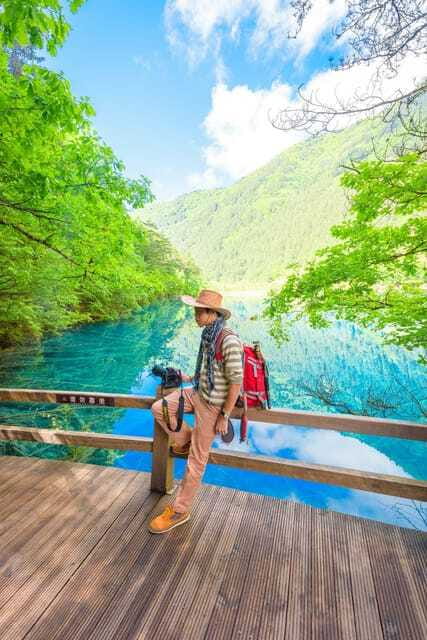
The first sightseeing block lasts about three and a half hours and combines photo stops, walking, sightseeing, and self-guided time. You will use the park transport system to reach scenic areas, then explore on foot along the built paths.
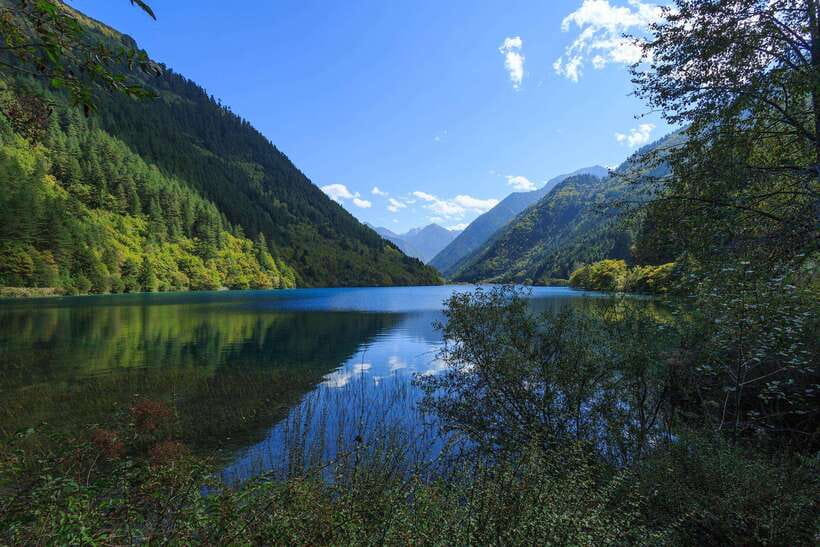
The paths are one of the park’s strengths. They bring you close to the major viewing areas without requiring difficult route-finding. You can stop often for photos, and you should. The water, tree reflections, and layered mountain shapes change quickly as you move from one section to another.
This is also where you need to manage your expectations. A three-and-a-half-hour block may sound generous, but Jiuzhai Valley is vast. You will not see every lake in a single day. If you stop at every viewpoint for a long photo session, your route will shrink fast.
I would treat the first part as a scouting session. Notice which kinds of views matter most to you. Some people prefer wide lake views, while others want waterfalls and forest paths. The park’s variety means you can make the day more personal, but only if you avoid trying to photograph everything.
Crowds can affect the rhythm. During the summer holiday period, walking may slow down enough that a short path takes much longer than expected. Give yourself room between major stops. A rushed day can turn a beautiful park into a checklist.
Same region, a different park day:
- Tenerife: Teide National Park Sunset & Stargazing Tour
★ 4.2 · 3,812 reviews - Discover Rocky Mountain National Park
★ 5.0 · 3,419 reviews - Mt. Rainier National Park Highlights Tour
★ 5.0 · 3,156 reviews - Grand Canyon National Park South Rim Bus Tour from Las Vegas
★ 4.5 · 3,071 reviews
The one-hour lunch break at Norilang
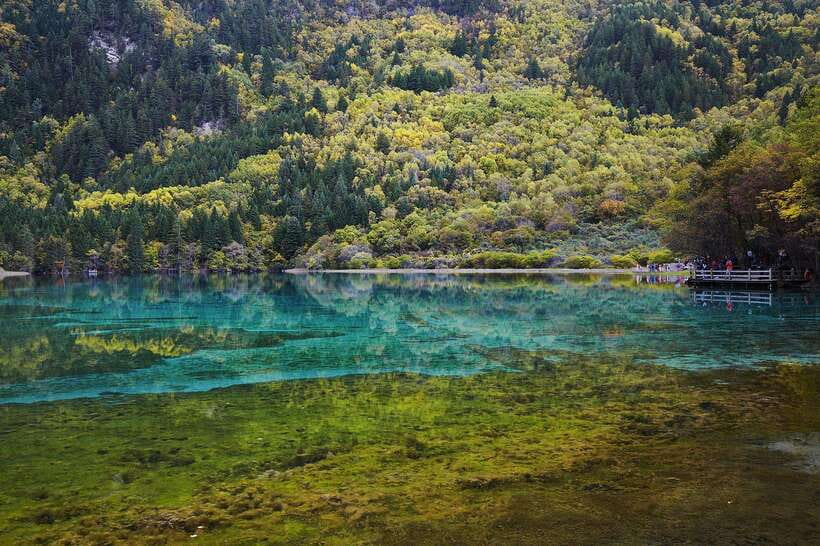
The planned break lasts one hour and includes lunch and free time. A buffet lunch at Norilang Restaurant is available as an optional addition. This is useful because it keeps the middle of the day simple, especially when you do not want to spend valuable sightseeing time searching for food.
Food and drink stalls are also available along different paths, along with toilets. These basic services matter in a large mountain park. You can take a proper break rather than treating lunch as something to squeeze in while walking.
The optional nature of the buffet is important when comparing the price. The base cost is $38 per person for the park ticket and sightseeing bus ticket, while lunch may cost extra. Hotel pickup and drop-off are also optional, so check exactly what your chosen package includes before payment.
I like having the choice. If you prefer a set meal and a predictable break, Norilang makes sense. If you want to keep moving or control your food spending, use the available stalls instead. Do not assume every extra service is included in the headline price.
The final four hours: waterfalls and the wider valley
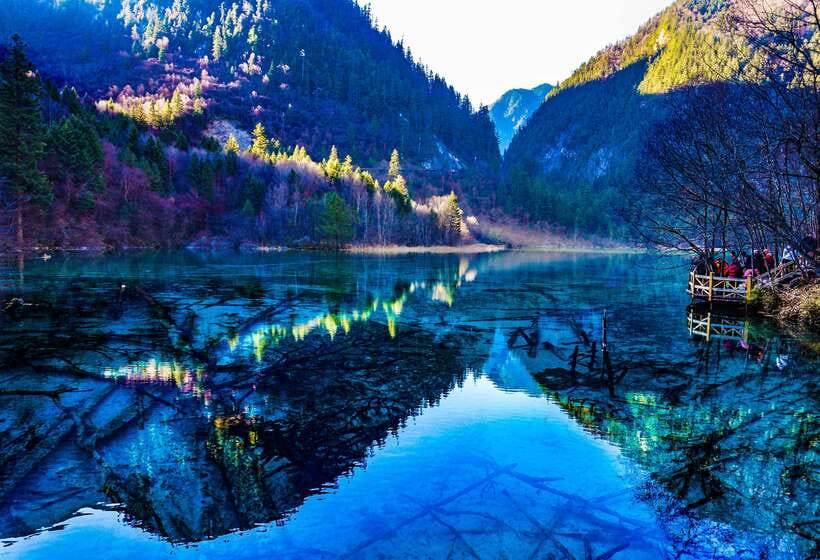
The second sightseeing block lasts about four hours. It follows the same pattern of photo stops, visits, walking, and self-guided exploration. This longer stretch gives you time to focus on the sections you could not cover earlier.
The waterfalls deserve real attention. Jiuzhai Valley’s falls often spread across several levels, with clean water moving over rock and through trees. They are not all viewed in the same way, so do not judge them from a single stop. Some are best appreciated from a wider platform, while others reward a slower walk along the path.
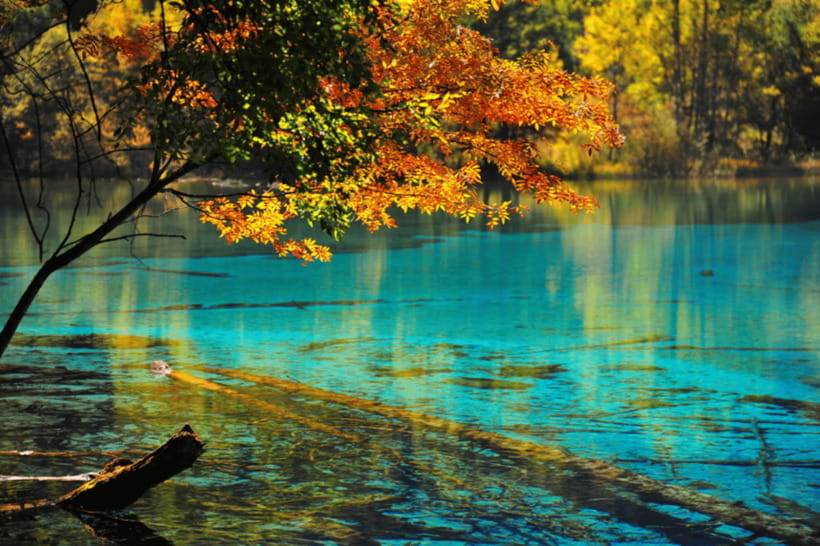
The forest changes the mood of the park. In autumn, leaves add strong color around the lakes. In winter, snow covers branches and mountain slopes, giving the water a sharper contrast. Warm clothing and warm shoes are sensible at any time, since weather can feel different from the entrance to higher sections.
The final four hours can also expose the limits of a one-day ticket. With such a large area, you may need to choose between more lakes, more waterfalls, or a longer walk. The sightseeing bus helps you shift between zones, but it cannot create extra hours.
If you have a second day, use it for the places you had to skip. One full day gives you a striking sample of the park. Two days would make the visit less hurried and give you a better chance to explore beyond the most convenient stops.
Tibetan culture beyond the scenery
Jiuzhai Valley is not only a collection of lakes. The nine Tibetan villages that give the park its name remain part of its identity, and people in the area still maintain traditional ways of life.
The experience may include local Tibetan music and dance, described as warm and welcoming. Treat this as a cultural element that complements the scenery, not as a full cultural tour with a detailed schedule. The supplied information does not promise a specific performance time or format.
That distinction matters. If your main goal is photography, you can enjoy the music and village context as an added layer. If your main goal is an in-depth study of Tibetan culture, you may want to arrange extra time or a separate cultural experience.
I appreciate that the park’s human story is not entirely pushed aside by the natural views. The lakes may be the reason you come, but the villages explain why the valley has its particular name and character.
Is $38 good value?
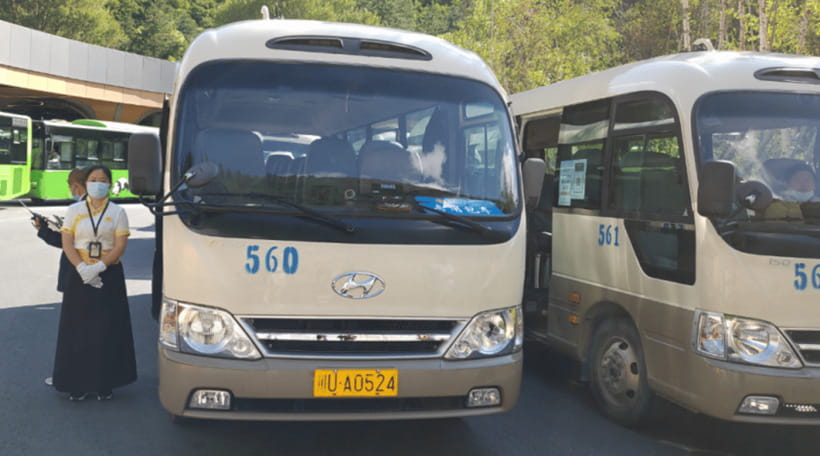
At $38 per person, the package offers good value if the price you select includes both the national park entry and the sightseeing bus. The bus is especially important because the park covers a huge area and a one-day visit depends on moving efficiently.
The value is less clear if you add every optional service without checking the final total. Buffet lunch and exclusive hotel pickup and drop-off are listed as optional. Those extras may be worthwhile for convenience, but they should be compared with your own transport and food plans.
The strongest part of the arrangement is the ticket support. Securing entry on a busy day can be stressful, and the booking contact can help with details before you arrive. Theo Du is available as a Chinese contact, and dedicated service staff can also help with itinerary planning and other attraction bookings.
The package does not include a guide fee. For many people, that keeps the cost sensible. You can use the bus, paths, signs, and your own pace to see the park. You pay extra only if you want a guide or other personal services.
What to bring and who should skip it
Wear comfortable shoes. You will walk between scenic areas, and even a bus-assisted day includes plenty of time on foot. Warm clothing and warm shoes are also listed as essentials, particularly in cooler seasons or at higher elevations.
Comfortable clothes are more useful than anything formal. This is a full day of walking, stopping, boarding buses, and standing at viewpoints. Alcohol and drugs are not allowed.
The experience is not suitable for people over 80 according to the activity information. That does not tell you every detail about individual mobility needs, so anyone with specific concerns should ask the service team before booking.
This visit suits you best if you want major natural sights with basic transport already arranged. It is a good match for photographers, first-time visitors to Sichuan, and people who prefer independent sightseeing without paying for a full private guide.
It is less suitable if you dislike crowds, want a slow forest walk, or expect to see the entire park in one day. The park rewards time, and the most common mistake is trying to force too much into a short schedule.
Booking flexibility and practical support
You can cancel up to 24 hours before the activity for a full refund, and the reserve-now-pay-later option lets you hold your place without paying immediately. Availability and start times can change, so check the date that suits you.
Confirmation can be fast, with the quickest stated time being 10 minutes. Do not rely on speed alone, though. Send the required passport and nationality details promptly so the ticket process does not stall.
The activity is valid for one day. Chinese and English support is available, and the service team can answer questions, help with itinerary planning, and assist with booking other attractions.
Should you book Jiuzhai Valley National Park?
Book it if you want access to one of China’s most striking natural parks and value the simplicity of having the entry ticket and sightseeing bus arranged together. The colorful lakes, clear tiered waterfalls, forests, and Tibetan setting give you plenty to see in a single day.
I would book with realistic expectations. One day will show you the park’s main appeal, but it will not reveal every corner. If you can spare two days, do so. If you have only one, arrive prepared to choose, keep lunch efficient, and use the bus wisely.
The $38 starting price is attractive for the core ticket and transport, while optional lunch and hotel transfers let you add convenience. For a self-guided visit with English and Chinese support, this is a practical choice. Just remember that the true luxury here is time, and the valley can use more of it.
FAQ
Where is Jiuzhai Valley National Park?
Jiuzhai Valley is in the Min Shan mountain range in northern Sichuan, southwestern China. It is part of the Aba Tibetan and Qiang Autonomous Prefecture.
How much does this experience cost?
The listed price is $38 per person. Optional additions, including the Norilang buffet lunch and exclusive hotel pickup and drop-off, may cost extra.
How long does the visit last?
The experience is valid for one day. The planned sightseeing includes about three and a half hours before lunch and four hours afterward, with a one-hour break.
Are park entry and the sightseeing bus included?
Yes. The Jiuzhai Valley National Park ticket and the park sightseeing bus ticket are included.
Is lunch included?
A buffet lunch at Norilang Restaurant is available as an optional service. Food and drink stalls are also available along different paths.
Is a tour guide included?
No. Guide fees are not included. The visit is designed mainly around self-guided sightseeing, and Chinese and English support is available.
What information is needed to book?
You need to provide each person’s full name, nationality, passport number, and contact details after booking.
Can I cancel the booking?
Yes. You can cancel up to 24 hours in advance for a full refund.
What should I bring?
Bring comfortable shoes, warm clothing, warm shoes, and comfortable clothes. Alcohol and drugs are not allowed in the experience.
Newest park tours we have reviewed in the world
- Half-Day Rocky Mountain National Park “Lake and Meadows Tour”★ 5.0 · 59 reviews
- Winter / Spring Private Rocky Mountain National Park Guided Tour★ 5.0 · 52 reviews
- Rocky Mountain National Park- Guided Hiking Tour★ 5.0 · 5 reviews
- Rock Climb Rocky Mountain National Park★ 5.0 · 2 reviews
- Full-Day Rocky Mountain National Park “Over The Top Tour” – RMNPhotographer★ 5.0 · 42 reviews
- Private Winter Tour + Sledding in Rocky Mountain National Park★ 5.0 · 2 reviews
- Women’s Hike to Ouzel Falls in Rocky Mountain National Park★ 5.0 · 2 reviews
- Half-Day Rocky Mountain National Park “Mountains to Sky Tour” – RMNPhotographer★ 5.0 · 89 reviews